Recent advances in EERI’s Learning From Earthquakes program
Synopsis
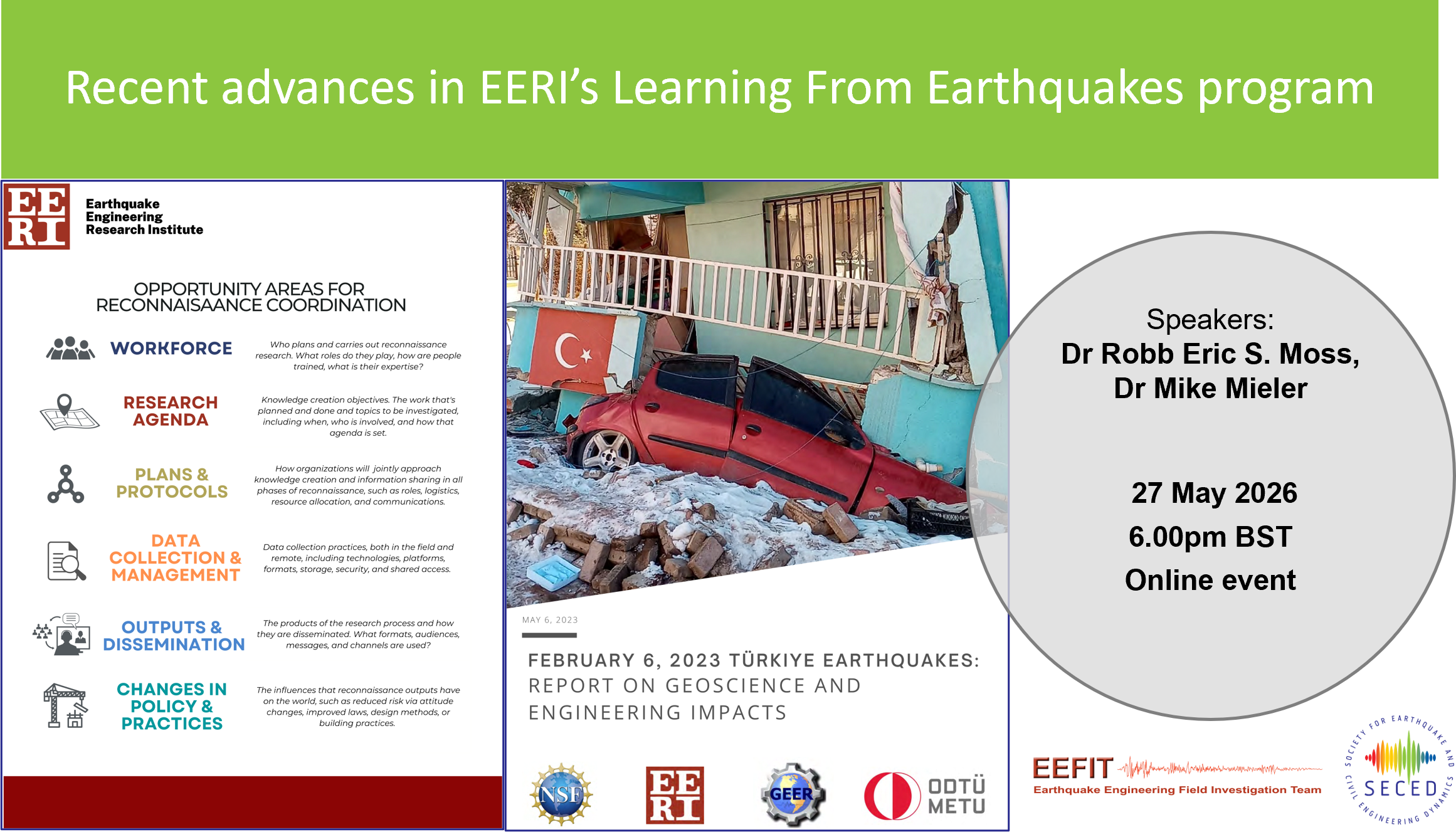
The earthquake reconnaissance landscape in the United States has evolved significantly over the past 10-15 years. This presentation will discuss recent contributions of EERI’s Learning From Earthquake (LFE) program within this new landscape, including a stakeholder workshop on organizing post-earthquake reconnaissance to optimize impact at 12NCEE in Salt Lake City and the multi-phase, interdisciplinary deployments to Türkiye following the 2023 Kahramanmaraş Earthquake sequence. The presentation will also highlight future priorities and initiatives for the LFE program.
About the speakers
Robb Eric S. Moss has been a professor in the Civil and Environmental Engineering Department at California Polytechnic State University, San Luis Obispo, since 2006. He earned a PhD from UC Berkeley in the field of geotechnical earthquake engineering, with minors in engineering seismology and structural reliability. His research and consulting focuses on the physics and probability of natural hazards such as; strong ground motions, seismic soil liquefaction, surface fault rupture, seismic induced landslides, debris flow, and others. His teaching includes courses in; geotechnical engineering, engineering risk analysis, geological engineering, and earthquake engineering. He was a member of ten earthquake reconnaissance teams to date traveling to Nepal, Japan, Chile, Alaska, Turkiye, India, Mexico, and around California. Robb was appointed a Fulbright Scholar to Chile for 2017-2020, and was an editor for the ASCE Journal of Geotechnical and Geoenvironmental Engineering the top in his field. He is a leading researcher in the areas of seismic soil liquefaction and surface fault rupture, directing international research teams in developing predictive models for forecasting the engineering implications of these hazards. He has authored/co-authored > 125 publications (h-index 31, i10-index 63), and serves on steering committees of two federally funded research consortiums, GEER (Geotechnical Extreme Events Reconnaissance) out of Georgia Tech, and NHR3 (Natural Hazards Risk and Resiliency Research Center) out of UCLA. He is currently co-director of the LFE (learning from earthquakes program) for EERI. Robb advises undergraduate and masters researchers at Cal Poly, doctoral researchers at UC Berkeley, METU in Turkiye, HUJI in Israel, and post-doctoral researchers from Iran and China.
Dr Mike Mieler is an Associate at Arup in the Risk and Resilience team in San Francisco with over 10 years of experience in climate and resilience projects in the built environment. His work focuses on assessing and mitigating the impacts of earthquakes and other natural hazards on complex societal infrastructure systems, including university campuses and networks of datacenters. He received his doctorate from UC Berkeley in Civil and Environmental Engineering in 2012, where he developed a performance-based engineering framework for linking broad, community-level resilience goals to specific performance objectives for individual buildings and lifelines. He recently served as the co-chair of EERI’s “Learning From Earthquakes” program from 2021-2025, and has participated in numerous earthquake reconnaissance field studies, including leading multi-disciplinary teams to investigate the resilience and recovery of impacted communities following the 2023 Kahramanmaraş Earthquake Sequence, the 2018 Anchorage Earthquake, and the 2015 Gorkha Earthquake.
Join online
The event will be online only. Click the link here to attend the meeting online on Teams.
Further information
The event is organised by the Earthquake Engineering Research Institute (EERI) and co-badged with the Earthquake Engineering Field Investigation Team (EEFIT) and SECED. The event is open to all and is free to attend.
Event Details
| Event Date | 27/05/2026 6:00 pm |
| Event End Date | 27/05/2026 7:30 pm |